The AI Adoption Paradox: Why Investment Is Soaring While Transformation Stalls
92% of companies are increasing AI investment. Only 1% are 'mature' in deployment. The answer lies in organizational psychology — not technology.
92% of companies plan to increase their AI investments over the next three years. Only 1% of leaders describe their organizations as 'mature' in their use of artificial intelligence. This isn't a statistical glitch or a survey error — it's the paradox that defines the current moment in business. And it reveals why the AI adoption problem isn't where most people are looking for it.
Welcome to the collaboration.tech blog. In this first post we show why AI transformation is, first and foremost, a psychological, organizational, and human challenge — and only after that a technological one. And why companies that understand this are already capturing twice the revenue growth of the rest of the market.
Three numbers that change how we think about AI
McKinsey's 'Superagency in the Workplace' report (January 2025) made the picture unambiguous: almost every company is investing in AI, and almost none is converting that investment into real value. In numbers:
- 92% of companies will increase their AI investment over the next three years
- 1% of organizations are 'mature' in AI deployment
- 47% of C-suite leaders believe their company is moving too slowly on AI
Boston Consulting Group, in its 'The Widening AI Value Gap' report (September 2025), adds an equally striking financial picture:
- 5% of companies are AI leaders ('future-built') — they systematically generate substantial value from AI
- 60% are laggards — minimal or zero financial returns despite their investment
- AI leaders expect twice the revenue increase and 40% greater cost reductions than laggards, in the areas where they apply AI
This is not a technology gap. It's an organizational one.
The 10-20-70 rule: where AI value actually comes from
BCG has articulated one of the most important principles of AI transformation today. It sounds simple — but its implications run deep:
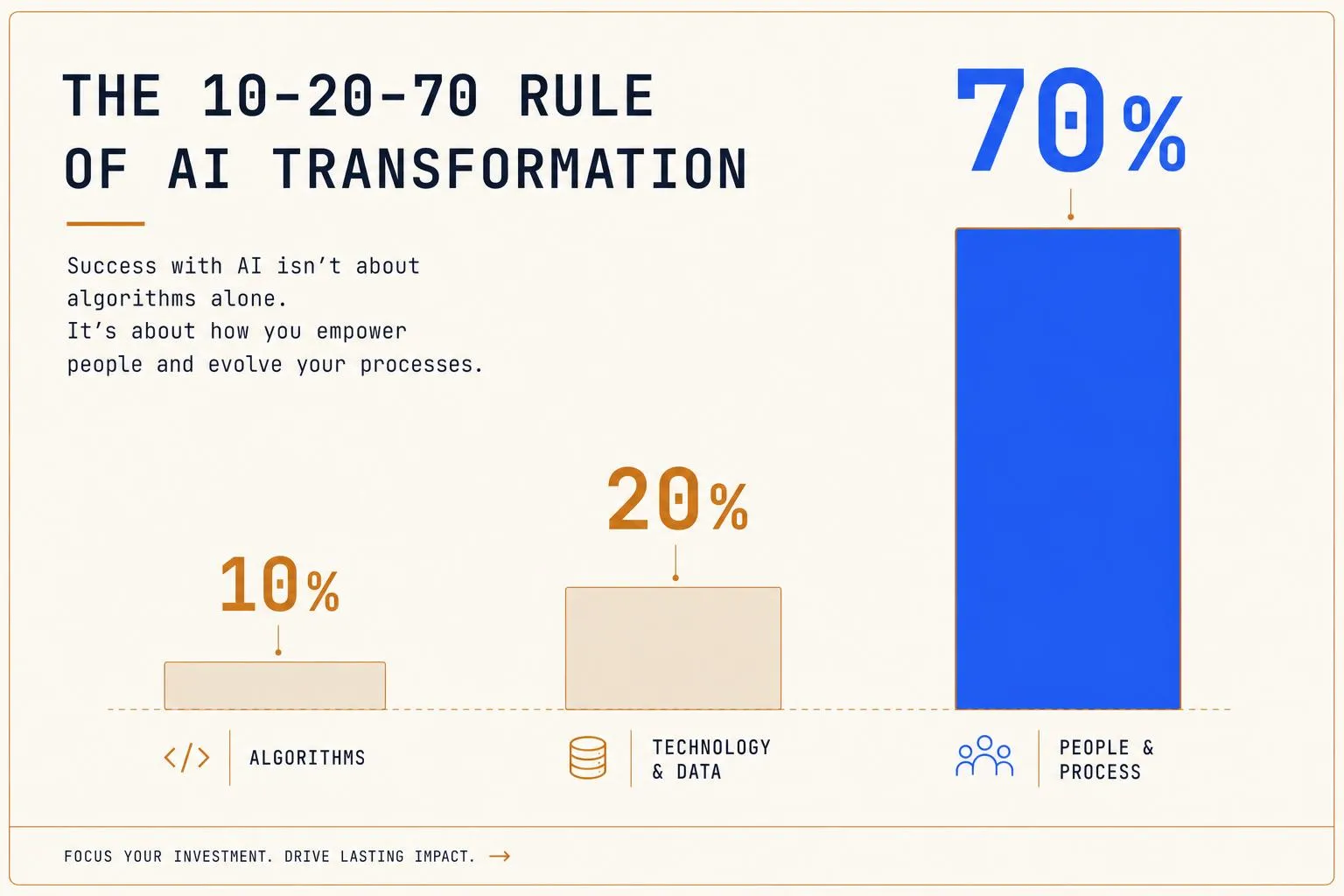
10% of effort on algorithms. 20% on technology and data. 70% on people and processes.
Read that twice. Seventy percent. The bulk of the work in an AI transformation is work on humans — on motivation, trust, capability building, team design, decision-making structures, and organizational culture. Not on models, and not on cloud infrastructure.
Most companies do the exact opposite. 70% of their energy goes to technology, 20% to processes, and 10% — if anything — to people. That's the paradox. That's the 99% of organizations that can't convert investment into value.
The 'jagged frontier': when AI helps, and when it hurts
In 2023, Harvard Business School and BCG conducted one of the most rigorous studies to date on AI's impact on knowledge work. 758 BCG consultants (about 7% of the firm's global workforce) performed realistic tasks either with or without access to GPT-4.
For tasks inside the so-called 'frontier of AI capability' (Dell'Acqua et al., 2023), the results were striking:
- +12.2% more tasks completed
- +25.1% faster completion
- +40% higher quality
But there's a second finding that rarely gets discussed out loud. When the same consultants used AI on tasks outside that frontier — tasks AI isn't yet competent at — their performance was 19% worse than the group not using AI at all. Artificial intelligence didn't just fail to help. It actively hurt.
This 'jagged technological frontier' is one of the most important concepts for anyone deploying AI. Artificial intelligence isn't uniformly good or uniformly bad. It has patchy competence — and it demands judgment from humans about when to trust it and when to keep distance. That's a capability you can't buy with a license. You have to build it inside the organization.
Trust, psychological safety, and alienation
This is where it gets interesting — and where organizational psychology enters the picture in earnest.
Trust in AI erodes over time. Initial excitement about a tool gives way to disappointment as people discover its limitations (Schmutz et al., 2024). That's a natural psychological process — but for organizations it means the 'wow effect' of the first few weeks fades, and then the real work begins: calibrating expectations, designing processes, building respect both for what AI can do and for where it falls short.
What's more, research shows that adding AI to a team often reduces coordination, communication, and trust between people (Schmutz et al., 2024). Hybrid teams (Human-AI Teams, HATs) counterintuitively perform worse than teams without AI. Why? Because people don't know how to collaborate with an agent that has no intuition, doesn't remember yesterday's agreement, and doesn't feel the consequences of an error. This isn't a lack of training on the tool. It's a missing new mental model of collaboration.
Bezrukova et al. (2023) discovered an even more counterintuitive finding: when teams with a positive attitude toward AI were mandated to use it, their level of collaboration declined. When teams with negative attitudes received the same mandate, collaboration paradoxically rose. These are results you can't fix with better technology. They demand an understanding of psychology — autonomy, attitude congruence within a group, and power dynamics.
One small but important note: in measurements like these, the average attitude of a team tells you almost nothing. What matters is the distribution and the congruence. A team in which everyone sits at 6/10 behaves completely differently from a team in which half sit at 10 and half at 2 — even though the average is identical.
And this brings us back to psychological safety — the concept made famous by Amy Edmondson at Harvard Business School. Without it, employees won't experiment with AI. They won't speak up when AI is wrong. They'll hide their doubts. And the entire technology investment will turn out to be — a costly empty gesture. A Loyola University study (Tsagaroulis, 2025) found that poorly considered AI adoption undermines psychological safety, which in turn substantially increases the risk of depression among employees. This is not an add-on to a 'soft topics' agenda. This is the heart of the problem.
What actually separates leaders from laggards
Back to BCG: 'future-built' companies invest 120% more in AI transformation than the rest of the field. But the key difference isn't financial. The key difference is where they allocate their effort.
Leaders:
- anchor their AI strategy in the business vision — they don't buy AI for AI's sake; they embed it inside existing goals
- invest in people and processes versus technology at roughly 70:30 — the opposite of the rest of the market
- train more than half of their workforce in AI capabilities; laggards plan to train about one-fifth
- design new roles and career paths — instead of forcing AI into existing, unchanged positions
- actively manage trust and a culture of experimentation — because they know without it the whole investment collapses
In other words: AI leaders are companies that understand technology adoption is a change management project — not an IT project.
The limits of AI: what artificial intelligence won't do for you
Time for some honesty. AI handles business strategy well — data analysis, scenario modeling, generating decision options. Csaszar et al. (2024) showed that large language models can generate and evaluate strategies at a level comparable to human experts.
But AI won't write your mission. It won't generate a credible vision. And it certainly won't connect strategy with mission and vision in a way that's authentic and motivating to employees. This isn't a limitation of current models that will disappear with the next generation. It's a limitation in principle — because mission and vision are artifacts of human meaning, identity, and values. AI doesn't possess any of the three.
That's why real AI transformation in an organization isn't about replacing humans. It's about a deliberate division of roles between humans and AI — with full clarity about where each side has the advantage, and where its limits begin.
What 'psychologically informed' AI adoption looks like
At collaboration.tech we believe the gap between ambition and maturity — that famous gap between 92% and 1% — is currently the biggest market opportunity for companies willing to treat AI transformation as a sociotechnical problem. Concretely:
Measure the sources of trust problems with AI. Don't assume people will 'get used to it.' Diagnosis precedes intervention. You need to know what specifically in the employee's experience with AI is generating distrust — whether it's hallucinations, opacity, or a sense of lost control.
Separate social processes inside the team from transactions with AI. They aren't the same — even though they happen inside the same tools. Team cohesion has to be designed completely differently from collaboration with an AI agent.
Monitor and influence work motivation. Especially where 'algorithmic management' enters the picture. Research shows that intensive algorithmic management nearly doubles stress levels and increases psychosocial risks by 21% (Bowdler et al., 2026). That's not a price worth paying for efficiency.
Measure attitude congruence, not the average. Average team sentiment toward AI is misleading. The distribution — which half is enthusiastic and which half is afraid — determines actual dynamics.
Design capability development to prevent skill erosion. Over-reliance on AI leads to skill erosion, which Penttinen and Ruissalo (2025) demonstrated in an accounting firm: when the automation was removed, employees could no longer perform basic tasks. This isn't a doomsday scenario. It's a field study.
What you'll get by reading this blog
In upcoming posts on collaboration.tech we will:
- show concrete organizational-psychology tools that work in AI transformation
- analyze real-world company cases — both successes and painful failures
- explain the latest research at the intersection of AI, neuroscience, work psychology, and organizational design
- give you decision frameworks — no hype, no marketing, just an evidence-based approach
If your company sits somewhere between those 92% and 1% — investing, but not yet winning — you're in the right place.
In the next article we'll unpack psychological safety in the AI era — with concrete measurement and concrete interventions that work.
Sources
- McKinsey & Company (2025). Superagency in the Workplace: Empowering People to Unlock AI's Full Potential at Work.
- Boston Consulting Group (2025). The Widening AI Value Gap: Build for the Future 2025.
- Dell'Acqua, F., McFowland III, E., Mollick, E. R., et al. (2023). Navigating the Jagged Technological Frontier. HBS Working Paper 24-013.
- Schmutz, J. B., Outland, N., Kerstan, S., et al. (2024). AI-teaming: Redefining collaboration in the digital era. Current Opinion in Psychology.
- Bezrukova, K., Griffith, T. L., Spell, C., et al. (2023). Artificial Intelligence and Groups. Group & Organization Management.
- Csaszar, F. A., Ketkar, H., & Kim, H. (2024). Artificial Intelligence and Strategic Decision-Making. Strategy Science.
- Bowdler, M., et al. (2026). Algorithmic management and psychosocial risks at work. Scandinavian Journal of Work, Environment & Health.
- Penttinen, E., & Ruissalo, J. (2025). Skill erosion caused by AI. Aalto University.
- Asfahani, A. M. (2022). The Impact of Artificial Intelligence on Industrial-Organizational Psychology. The Journal of Behavioral Science, 17(3), 125–139.
Continue reading
What Is an Enterprise AI Adoption Framework? The RECODE Method, Explained for Boards and C-Level
An enterprise AI adoption framework is a structured operating model that moves AI from scattered pilots to measurable P&L impact. A field guide to the RECODE Method, why 95% of pilots fail, and why AI augments human work but never collaborates.
How to Audit AI–Human Collaboration Quality: A 4-Dimension Methodology
Most 'human-AI collaboration' audits measure tool usage. This guide shows the four dimensions — goal alignment, boundary spanning, cognitive diversity, psychological safety — and the metrics and questions a professional audit actually uses.
AI Adoption in Healthcare: Why Most Rollouts Fail — and How to Join the 5% That Win
95% of enterprise GenAI pilots produce no measurable impact. In healthcare the stakes go beyond ROI — to patient safety and EU AI Act compliance. Here's what the winning 5% do differently.
Eliza in the Boardroom: Why a Successful AI Demo Doesn't Mean You're Ready for AI Transformation
An impressive AI demo says nothing about how your organization actually works underneath. Boards make the same cognitive error as AI enthusiasts — confusing effect with mechanism.
H2H vs H2M: Why Cross-Functional Collaboration Is the Real Innovation Engine
Innovation comes from people across functions working on aligned goals — not from another tool. Why H2M stalls without H2H, and the four mechanisms that turn diverse functions into one engine.