Human-in-the-Loop AI Implementation: How Do You Design Oversight That Actually Works?
Human-in-the-loop AI implementation comes down to five steps: map decisions, match oversight to risk and reversibility, design a control point with real authority, measure intervention quality, and assign ownership. Without metrics, the human in the loop becomes a rubber stamp.
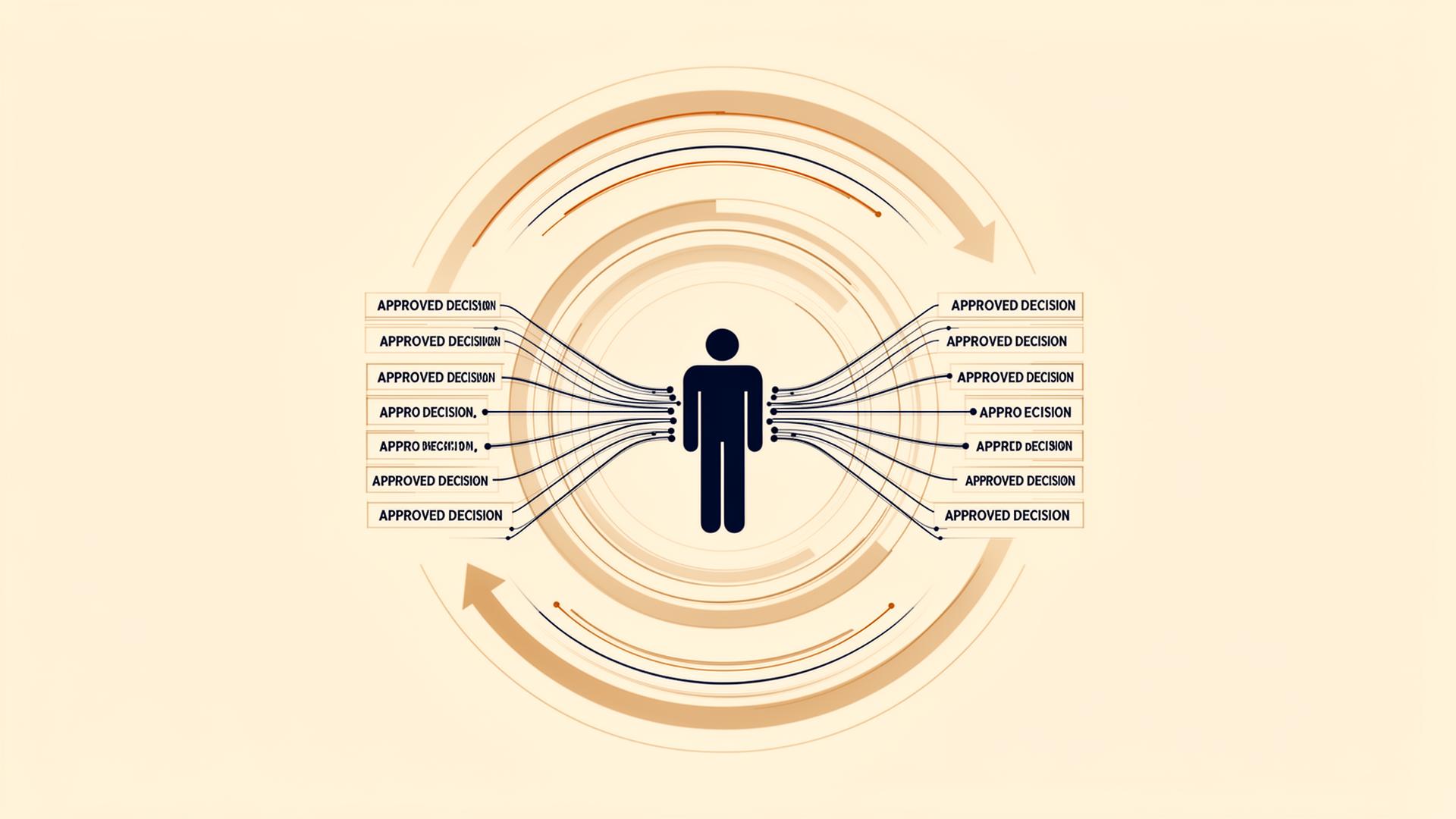
Human-in-the-loop AI implementation comes down to five steps: map the decisions your AI system makes, match the oversight model to each decision's risk and reversibility, design a control point with real authority, measure intervention quality, and assign ownership to named people. Without metrics, oversight exists only on a slide — and the human in the loop becomes a rubber stamp.
TL;DR — Key takeaways
- Only 27% of organizations using generative AI say employees review all of its output before use; a similar share reviews 20% or less (McKinsey, 2025).
- Oversight is matched to individual decisions, not to whole systems. The tool is a simple matrix: cost of error × reversibility of consequences.
- Automation bias affects experts as much as novices, and training alone does not remove it (Parasuraman & Manzey, 2010). The loop must be designed against it, not around it.
- An override rate near zero on an imperfect system is an alarm, not a success.
- A loop works when the people around it work together: operator, process owner, compliance. AI is a tool inside the loop, not a participant in it.
What does implementing human-in-the-loop AI actually involve?
Human-in-the-loop implementation means designing a process so the AI system cannot finalize specified actions without a human decision. It is a property of process architecture, not a feature in a tool. An "approve" button without time, context, and authority on the human side is not oversight — it is decoration.
The scale of the gap is measurable. 88% of organizations now use AI in at least one business function, yet only 7% have fully scaled their deployments (McKinsey, 2025). At the same time, just 27% of companies using generative AI say employees review all of its output before use. A similar share checks 20% or less of generated content (McKinsey, 2025).
That gap has consequences. MIT Project NANDA (2025) found that roughly 95% of enterprise generative AI pilots produce no measurable P&L impact. One recurring cause is the absence of a designed control loop: the organization does not know when to trust the system's output, so it checks everything — or nothing.
The definitional groundwork — how human-in-the-loop differs from human-on-the-loop, and why it is coordination rather than collaboration — is covered in our companion article on what "human in the loop" really means. This article answers the implementation question.
Where should the human sit in the loop? A risk-and-reversibility matrix
The most common implementation mistake is assigning oversight to a system ("this system has human-in-the-loop"). Oversight is assigned to a decision. A single system makes dozens of different decisions with very different risk profiles.
Two questions structure the choice: how much does an error cost, and can the consequence be undone?
- High cost · reversible → Human-on-the-loop: AI acts, a human monitors and takes over exceptions.
- High cost · irreversible → Human-in-the-loop: a human approves every decision.
- Low cost · reversible → Full automation with sample audits.
- Low cost · irreversible → Human-on-the-loop with escalation thresholds.
The matrix maps onto the four rungs of AI autonomy. At the Assist rung, the human is in the loop by definition — AI drafts, the human edits and sends. At the Augment rung, AI processes what no human could (say, 50,000 support tickets a month) and the human decides based on the patterns. At the Automate rung, AI runs the process and the human enters on exceptions — for example, invoice classification with escalation above a set amount. At the Agentic rung, an agent plans and acts within guardrails, and the loop shifts from individual decisions to boundary design and audit. The higher the rung, the more expensive a flaw in the loop's design.
How do you design a control point where a human can actually intervene?
A control point is the moment in a process where a human sees the system's output and makes a decision. Article 14 of the EU AI Act translates this into concrete capacities: the overseeing person understands the system's capabilities and limitations, monitors its operation, can decide not to use an output, and can interrupt the system (Regulation (EU) 2024/1689). Following the provisional Digital Omnibus agreement of 7 May 2026, high-risk obligations take effect on 2 December 2027 (Annex III) and 2 August 2028 (Annex I) — but a loop is designed at deployment, not at the regulatory deadline.
In practice, a control point needs four elements:
- Context. The human sees not only the output, but the input data, the model's confidence level, and its rationale. Output alone forces guessing.
- Time. The time budget per case comes from task analysis, not from volume. If a sound review takes 4 minutes and the operator gets 40 seconds, the decision was already made by someone else.
- Authority. Four real options: approve, correct, reject, escalate. If rejection requires a manager's sign-off while approval takes one click, the process rewards approving.
- Feedback. Every correction flows back to the team maintaining the system. A loop without learning is a conveyor belt, not oversight.
How do you stop the human from becoming a rubber stamp?
Automation bias is the tendency to accept an automated system's recommendations uncritically. The research is blunt: it affects novices and experts alike, it produces both omission and commission errors, and training or instructions alone do not eliminate it (Parasuraman & Manzey, 2010).
This is not a theoretical risk. Ben Green (2022) analyzed 41 policies requiring human oversight of public-sector algorithms. His conclusion: people are generally unable to perform the oversight functions these policies assume, and the policies themselves create a false sense of security while legitimizing flawed systems (Green, 2022). For a deeper dive on calibrating reviewer trust, see our piece on trust calibration in human–AI collaboration.
Implementation therefore has to design the loop against automation bias:
- A decision cap per hour. Cognitive fatigue raises the share of reflexive approvals.
- Blind samples. In a random share of cases, the human decides without seeing the AI recommendation. The gap between blind and assisted decisions measures the system's real influence on people.
- Audits of approvals. Regularly inspect a sample of cases approved without correction — that is where missed errors hide.
- Effort symmetry. Approving and rejecting require the same effort, for example a one-sentence justification either way.
Which metrics show your human-in-the-loop implementation is working?
Oversight cannot be managed without numbers. The minimum set is four indicators: the override rate (the share of cases where the human changed or rejected the AI's output), time per case, agreement in blind samples, and the result of approval audits.
The override rate is the one most often misread. A value near zero on a system that is not perfect does not mean a brilliant model — it means a rubber stamp. A very high value means the system does not fit the process, or people do not trust it. Both extremes call for a change to the loop's design, not a change of people.
The loop also has a cost that belongs in the budget: human time multiplied by case volume. Validating AI output is one of the most commonly omitted hidden costs of AI deployments — alongside data preparation and error recovery. If that cost does not fit the business case, the problem is the business case, not the oversight.
Who owns the loop? Oversight is human work, not a system feature
The person in the loop does not collaborate with the system — they use a tool and control its output. They do collaborate with the other people who keep the loop alive: the process owner, the team maintaining the system, the risk and compliance function. And that is the part that fails most often.
Collaboration between people requires three conditions at once: aligned goals, compatible attitudes, and mutual knowledge of competencies (Wekselberg & Wasilewski, 2021). A human-in-the-loop implementation tests all three. An operator measured solely on throughput holds a goal misaligned with the quality goal — and the loop breaks in week one. A maintenance team that does not know the operator's competencies designs the review screen blind. Our field guide on real collaboration in AI transformation goes deeper on getting those three conditions right.
That is why implementing a loop is mostly work on people and processes. BCG's 10-20-70 rule states it plainly: 10% of an AI transformation effort is algorithms, 20% is technology and data, 70% is people and processes (BCG). The control loop is the hardest proof of that rule — technically trivial, organizationally demanding.
Where do you start? A 30-day implementation plan
- Week 1 — decision inventory. List the decisions your AI systems make or recommend. Assign each a cost of error and a reversibility rating.
- Week 2 — oversight model selection. Apply the matrix. Output: a list of decisions, each with an assigned model (in-the-loop / on-the-loop / automation with audit).
- Week 3 — control-point design. For every human-in-the-loop decision, define context, time, authority, and the feedback path. Name the loop owner — a person, not a function.
- Week 4 — metrics and thresholds. Start measuring the four indicators. Set alert thresholds — including a lower bound on the override rate.
- Day 30 — goal-alignment review. Check whether the operator's, the process owner's, and compliance's goals are aligned. If they are not, fix that first — then scale.
FAQ: Human-in-the-loop AI implementation
Do you need human-in-the-loop for every AI system?
No. Oversight is matched to individual decisions, not to systems. Decisions with a high cost of error and irreversible consequences require human approval; low-risk decisions can be automated with sample audits. For high-risk systems under the EU AI Act, effective human oversight is a legal requirement (Article 14).
What is a healthy override rate?
There is no single correct number. A rate near zero on an imperfect system signals rubber-stamping; a very high rate signals a system that does not fit the process, or a lack of trust. Track the trend, compare against blind samples and approval audits, and treat extreme readings as a design problem.
How much does human-in-the-loop implementation cost?
The base cost is human time multiplied by case volume, plus control-point design and metric upkeep. It is one of the most commonly omitted hidden costs of AI deployments. Price it before the pilot: if the business case cannot carry the cost of oversight, it cannot carry the cost of unoversighted errors either.
Does the human in the loop collaborate with the AI?
No. There is no such thing as human-AI collaboration. Collaboration is a social process between people, requiring aligned goals, compatible attitudes, and mutual knowledge of competencies (Wekselberg & Wasilewski, 2021). The person in the loop coordinates work with a tool — and collaborates with the people who design and maintain the loop.
What does Article 14 of the EU AI Act require?
Effective human oversight of high-risk systems: the overseeing person understands the system, monitors its operation, can decide not to use an output, and can interrupt the system. Following the provisional Digital Omnibus agreement (May 2026), obligations take effect on 2 December 2027 (Annex III) and 2 August 2028 (Annex I).
Sources
- McKinsey & Company (2025). The state of AI: How organizations are rewiring to capture value. QuantumBlack, AI by McKinsey.
- McKinsey & Company (2025). The state of AI in 2025: Agents, innovation, and transformation.
- MIT Project NANDA (2025). The GenAI Divide: State of AI in Business 2025. MIT Media Lab.
- Parasuraman, R., & Manzey, D. H. (2010). Complacency and bias in human use of automation: An attentional integration. Human Factors, 52(3), 381–410. DOI: 10.1177/0018720810376055.
- Green, B. (2022). The flaws of policies requiring human oversight of government algorithms. Computer Law & Security Review, 45, 105681. DOI: 10.1016/j.clsr.2022.105681.
- Regulation (EU) 2024/1689 (AI Act), Article 14 — human oversight. Provisional EU Council–Parliament agreement on the Digital Omnibus on AI, 7 May 2026.
- Boston Consulting Group. The 10-20-70 approach to AI transformation.
- Wekselberg, V., & Wasilewski, J. (2021). Kooperacja, współpraca, koordynacja, myślenie grupowe. Difin (English ed. Cooperation, collaboration, coordination, groupthink, 2023).
Continue reading
Human-in-the-Loop AI: What "A Human in the Loop" Actually Means — and Why It Isn't Enough on Its Own
"Don't worry, we keep a human in the loop" reassures the board — but the data says it guarantees nothing. Here's what HITL really is, why it's coordination (not collaboration), and how to design oversight that actually lowers risk.
How to Audit Collaboration Quality in AI-Augmented Work
You cannot audit "AI-human collaboration" — collaboration is a human social process, and an AI system is not a social partner. A real audit splits the question in two: Layer 1, human collaboration quality; Layer 2, human–AI coordination quality. This guide gives you the protocol.
AI Governance Ecosystem: How Regulations, Standards, and Frameworks Fit Together
Binding regulations, voluntary standards and management frameworks are not competing options — they are three layers of one ecosystem that converge on a single point of accountability inside your organization.
Where Does AI Fit Without Replacing Human Judgment?
AI fits in the coordination layer: gathering evidence, drafting options, monitoring processes. Human judgment stays where a decision is irreversible, contested, or attributable. Three tests, one decision table, and a 90-day plan for drawing the line.
Human-in-the-Loop vs Human-on-the-Loop: How to Choose the Right AI Oversight Model
Human-in-the-loop (HITL) and human-on-the-loop (HOTL) are not interchangeable labels. This guide compares them across ten dimensions, gives four tests for choosing per decision point, walks through healthcare and enterprise use cases, and shows how to implement the right model in 90 days.