Psychological Safety and AI Adoption: Why Do Employees Hide That They Use AI?
Psychological safety is the shared belief within a team that members can take interpersonal risks without fear of embarrassment or punishment. In AI adoption it settles one thing: whether people experiment with the tools openly or use them in hiding.
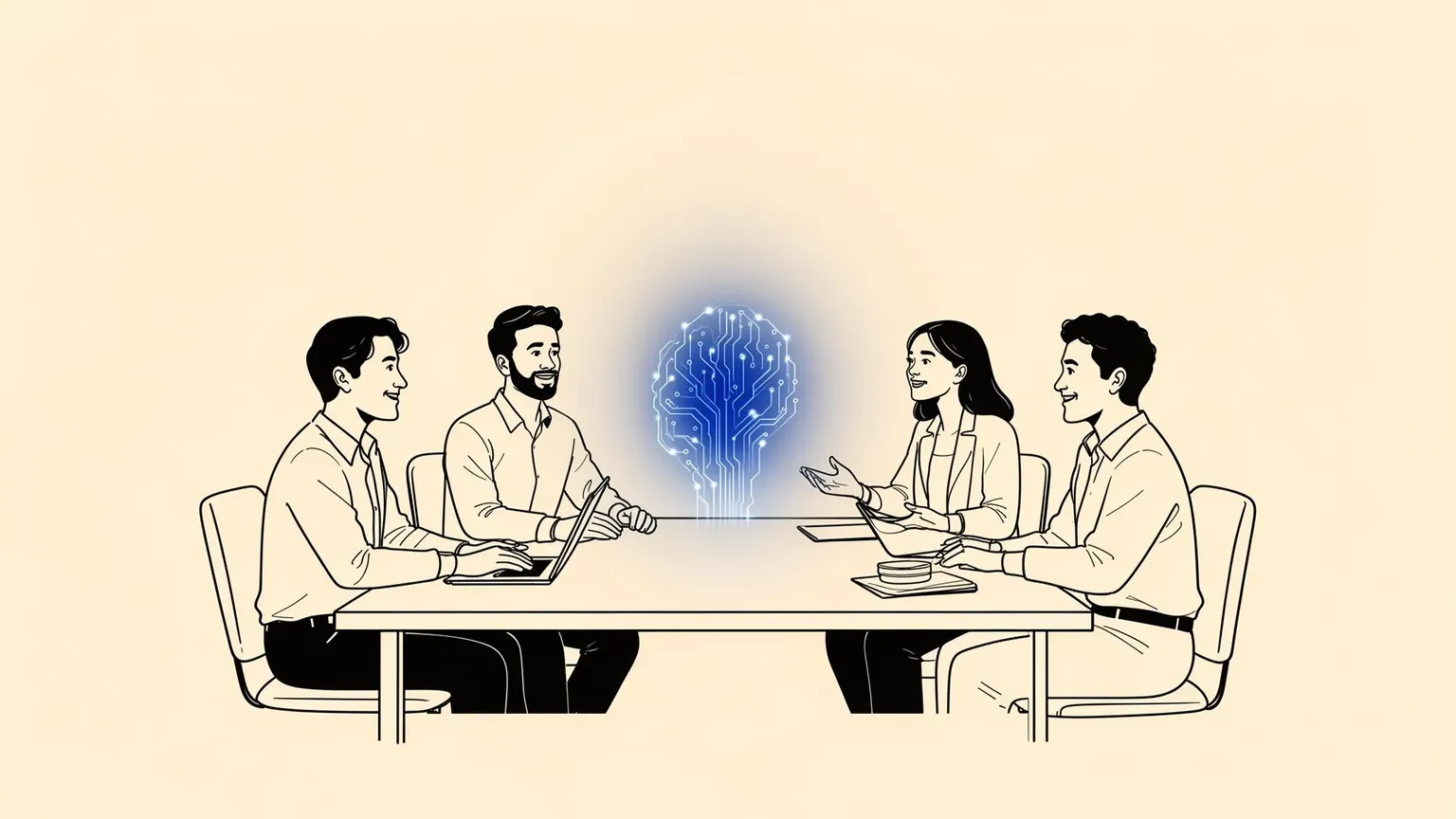
Psychological safety is the shared belief within a team that members can take interpersonal risks — ask a question, admit a mistake, raise a doubt — without fear of embarrassment or punishment (Edmondson, 1999). In AI adoption it settles one thing: whether people experiment with the tools openly or use them in hiding. The second option quietly kills the transformation.
TL;DR
- 57% of employees hide their use of AI and present AI-generated content as their own (University of Melbourne & KPMG, 2025).
- 53% of people who use AI at work worry it makes them look replaceable (Microsoft & LinkedIn, 2024).
- Psychological safety predicts whether an employee starts using AI at all — not how intensively they use it later (Reich et al., 2026).
- Hidden AI use breaks down the three conditions of collaboration described by Victor Wekselberg: aligned goals, compatible attitudes, and mutual knowledge of competencies.
- Below: the definition, the data, the mechanism, and a 6-step plan for building psychological safety.
What Is Psychological Safety? A Definition
Psychological safety is the shared belief among team members that their team is a safe place for interpersonal risk-taking. Amy Edmondson of Harvard Business School defined the concept in a study of 51 work teams published in Administrative Science Quarterly (Edmondson, 1999). "Interpersonal risk" sounds abstract, but in practice it is very concrete: asking "what are we actually doing this for?", admitting "I don't know how to use this tool," reporting "the model put wrong numbers in the report."
Psychological safety is not comfort, and it is not lowered standards. Edmondson shows that the teams that learn fastest combine high expectations with high safety — there, errors surface early and cheaply instead of late and expensively.
The evidence is strong. A meta-analysis of 136 research samples (more than 22,000 individuals in total) found that psychological safety is linked to engagement, information sharing, learning behavior, and task performance (Frazier et al., Personnel Psychology, 2017). Google's Project Aristotle analyzed more than 180 of its own teams and identified psychological safety as the most important of the five factors behind team effectiveness (Google re:Work, 2016).
Why Does Psychological Safety Decide AI Adoption?
Because AI adoption is a learning behavior, not a purchasing decision. A new tool demands testing it on your own work, asking "stupid" questions, showing failed prompts, and admitting the first week was a write-off. Every one of those behaviors is an interpersonal risk — precisely what psychological safety enables and what its absence blocks.
The data confirms the mechanism directly. In a study of 2,257 employees at a global consulting firm, psychological safety predicted whether an employee would reach for AI tools at all — regardless of tenure, role level, or region. It did not, however, predict how intensively they used AI afterwards (Reich et al., 2026). The takeaway for the board: psychological safety opens the door to adoption; past the threshold, what matters is the tool's usefulness and its integration into the workflow.
This completes the picture from the first article in this series. 92% of companies plan to increase their AI investment, yet only 1% of leaders describe their deployment as mature (McKinsey, 2025), and roughly 95% of enterprise generative-AI pilots produce no measurable impact on the P&L (MIT Project NANDA, 2025). The barrier rarely sits in the models. It sits in an organization that cannot learn on top of them — because people are afraid to say what works and what doesn't.
How Big Is the Hidden AI Use Problem? The Numbers
The scale is larger than most boards assume. According to the global study by the University of Melbourne and KPMG (48,000+ respondents across 47 countries), 57% of employees hide their use of AI and present AI-generated content as their own. At the same time, 66% rely on AI outputs without checking their accuracy, and 56% admit AI has caused them to make mistakes at work (Gillespie et al., 2025).
Microsoft and LinkedIn show the mechanism from the inside. In a survey of 31,000 knowledge workers across 31 countries, 75% reported using AI at work, and 78% were bringing their own private tools into the company (BYOAI). At the same time, 52% are reluctant to admit using AI on their most important tasks, and 53% worry that using AI makes them look replaceable (Microsoft & LinkedIn, Work Trend Index, 2024).
The conclusion is uncomfortable: most companies do not have an AI adoption problem. They have an adoption visibility problem. AI is already working inside the organization — the question is whether it works on the surface, where it can be managed, or underground, where it generates data-leak risk, unchecked errors, and quiet dependence on individual people.
What Does Hidden AI Use Destroy in a Team? The Three Conditions of Collaboration
Collaboration is a social process — it happens exclusively between people. Victor Wekselberg identifies three conditions that must be met simultaneously for collaboration to exist at all: aligned goals, compatible attitudes, and mutual knowledge of competencies. AI meets none of these conditions and cannot — AI coordinates, supports, and augments the work people do. That is why the question "how does AI affect collaboration?" really means: "how does AI affect these three conditions between people?"
Fear and hiding hit all three at once:
- Aligned goals. An employee afraid of looking replaceable starts optimizing a private goal: protecting their own position. The team is optimizing the outcome. Those goals stop being aligned — and without goal alignment there is no collaboration, only its appearance.
- Compatible attitudes. A single team now contains open enthusiasts, hidden users, and loud skeptics. Attitudes toward the tools drift apart, and the conversation that could reconcile them never happens — because the topic feels risky.
- Mutual knowledge of competencies. This is the most insidious effect. If 57% of people hide their AI use, the team no longer knows who can really do what. The picture of competencies is false: "Kate's excellent report" is in reality a report by Kate and a model no one knows about. Delegation, planning, and people development then rest on fiction.
Hidden AI use is therefore not a marginal ethics issue. It is a mechanism that dismantles collaboration from the inside — quietly and systematically.
There is also a feedback loop. A three-wave study of 381 employees found that AI implementation itself lowers psychological safety, and that drop raises the risk of depression; ethical leadership softens the effect (Kim, Kim & Lee, Humanities and Social Sciences Communications, 2025). In other words: AI rolled out through fear destroys the very foundation it needs.
How Do You Recognize the Level of Psychological Safety Around AI?
- Area: AI errors; Low psychological safety: swept under the rug, surface at the client; High psychological safety: reported immediately, discussed in retrospectives
- Area: Tools; Low psychological safety: private accounts, "shadow AI"; High psychological safety: open use of approved tools
- Area: Questions; Low psychological safety: basic questions never get asked; High psychological safety: "why?" and "how?" questions are rewarded
- Area: Talking about AI; Low psychological safety: official declarations, private worries; High psychological safety: open exchange: what works, what fails
- Area: Prompt knowledge; Low psychological safety: private advantage of individuals; High psychological safety: a practice the whole team draws on
If even two rows in the left column sound familiar, your AI implementation is standing on a foundation that is cracking.
How to Build Psychological Safety for AI Implementation: A 6-Step Plan
- Measure the starting point. Before you buy licenses, diagnose the level of psychological safety (Edmondson's seven statements) and the team's attitudes toward AI. Without measurement, every implementation decision is a guess.
- Start with yourself. The leader openly shows their own AI use — failed attempts included. Modeling fallibility is the cheapest and best-documented intervention for building safety.
- Replace the default ban with explicit rules. Publish the list of approved tools, the data classes that must never go in, and the path for proposing new use cases. It is easier to admit using AI when everyone knows what is allowed.
- Separate experiments from evaluation. Run pilots with an explicit error budget and blameless retrospectives. Grade the team's learning speed, not the number of failed prompts.
- Reward openness, not just results. Publicly recognize the people who show HOW they got the result — the prompts, the methods, the tools' limitations. AI knowledge should be team practice, not private advantage.
- Prepare managers for the first mistake. A manager's first reaction to a reported AI error sets the norm for months. Rehearse it before it happens: thank the person for reporting, analyze the causes, fix the process — in that order.
Want to know where your team sits on this map before you invest in more tools? Book a strategy call at collaboration.tech — we will show you how to diagnose goal alignment, attitudes, and mutual knowledge of competencies in your organization.
Coming next in this series: trust calibration — why both blind faith in the model and reflexive distrust cost you, and how to set the right level of reliance on the machine.
FAQ: Psychological Safety and AI
What is the difference between psychological safety and comfort?
Comfort is the absence of tension. Psychological safety is the ability to take interpersonal risks despite tension: asking hard questions, admitting mistakes, challenging decisions. Edmondson stresses that the best results come from combining high standards with high safety — that is when a team learns fast instead of comfortably defending the status quo.
How do you measure psychological safety in a team?
The starting point is Edmondson's seven statements, rated anonymously on an agreement scale — for example, "If you make a mistake on this team, it is often held against you." In the AI context, add questions about openness of tool use and reactions to reported errors. Repeat the measurement quarterly, at team level, not company level.
Why do employees hide that they use AI?
Out of concern for how they will be judged. 53% of people who use AI worry it makes them look replaceable, and 52% are reluctant to admit using it on their most important tasks (Microsoft & LinkedIn, 2024). When a company has no explicit rules, the rational strategy for an employee is quiet use — and signing the output with their own name.
Is psychological safety enough for lasting AI adoption?
No. A study of 2,257 employees showed that psychological safety predicts initial AI adoption but not the intensity of later use (Reich et al., 2026). It opens the door — whether people stay past the threshold depends on the tool's usefulness, its integration into the workflow, and real value in everyday tasks.
Where do you start building psychological safety before an AI rollout?
With measurement and with rules. Diagnose the level of psychological safety and the team's attitudes toward AI before you buy licenses. In parallel, replace the default ban with explicit rules of use. Only on that foundation launch pilots — otherwise your adoption data will be fiction and the errors will go underground.
Sources
- Edmondson, A. (1999). 'Psychological Safety and Learning Behavior in Work Teams'. Administrative Science Quarterly, 44(2), 350–383. DOI: 10.2307/2666999
- Frazier, M. L., Fainshmidt, S., Klinger, R. L., Pezeshkan, A., & Vracheva, V. (2017). 'Psychological Safety: A Meta-Analytic Review and Extension'. Personnel Psychology, 70(1), 113–165. DOI: 10.1111/peps.12183
- Google re:Work (2016). 'Guide: Understand team effectiveness' (Project Aristotle). rework.withgoogle.com
- Gillespie, N., Lockey, S., Ward, T., Macdade, A., & Hassed, G. (2025). 'Trust, attitudes and use of artificial intelligence: A global study 2025'. The University of Melbourne & KPMG. DOI: 10.26188/28822919
- Microsoft & LinkedIn (2024). 'Work Trend Index Annual Report: AI at Work Is Here. Now Comes the Hard Part'. microsoft.com/worklab
- MIT Project NANDA (2025). 'The GenAI Divide: State of AI in Business 2025'.
- McKinsey & Company (2025). 'Superagency in the workplace: Empowering people to unlock AI's full potential at work'.
- Reich, A., et al. (2026). 'Safety First: Psychological Safety as the Key to AI Transformation'. Working paper, study at a global consulting firm (N = 2,257).
- Kim, B.-J., Kim, M.-J., & Lee, J. (2025). 'The dark side of artificial intelligence adoption: linking artificial intelligence adoption to employee depression via psychological safety and ethical leadership'. Humanities and Social Sciences Communications, 12, 704. DOI: 10.1057/s41599-025-05040-2
- Wekselberg, V., & Wasilewski, J. (2023). 'Cooperation, collaboration, coordination, groupthink – what is it all about?' Difin (Polish ed. 2021). The three-condition framework of collaboration: Victor Wekselberg.
Continue reading
Shadow AI: Why Half of Your AI Adoption May Be Invisible to You
Shadow AI is AI use without your knowledge, approval, or governance. Gallup's undivided 52% hides it, the 47%-vs-25% plan gap feeds it, and only an instrument built on psychological safety can measure it.
Three in Four Companies Haven't Told Employees Why They're Implementing AI. What Fills That Silence?
Organizational AI integration surged from 38% to 47% in a year, while the share of employees who heard a clear AI plan stayed flat at 25% (Gallup, 2026). What grows in that silence — and the three elements a plan must contain to actually land.
The Anatomy of Shadow AI: Why Employees Hide Their AI Use — and What It Reveals About Your Organization
Workers at over 90% of companies regularly use personal AI tools, while only 40% of companies have official LLM subscriptions. Shadow AI is the cheapest organizational change audit you will ever get — here is how to turn it into managed adoption in 90 days.
How Cross-Functional Collaboration Drives Innovation (and Decides AI's Value)
Cross-functional collaboration drives innovation through four mechanisms — and it's the precondition for getting real value from AI, not a nice-to-have alongside it.
"Manager Support Increases AI Adoption 8.7×" — the Error in That Sentence Costs Real Budgets
Gallup's 8.7× multiplier appears in every AI transformation deck. It attaches to perceived transformation, not adoption frequency (1.7×), and it is correlational — which changes where your budget should go.